How an Epigenetic Clock Is Built
A tool trained to reproduce the birthday on your license turns out to be valuable only where it fails to.
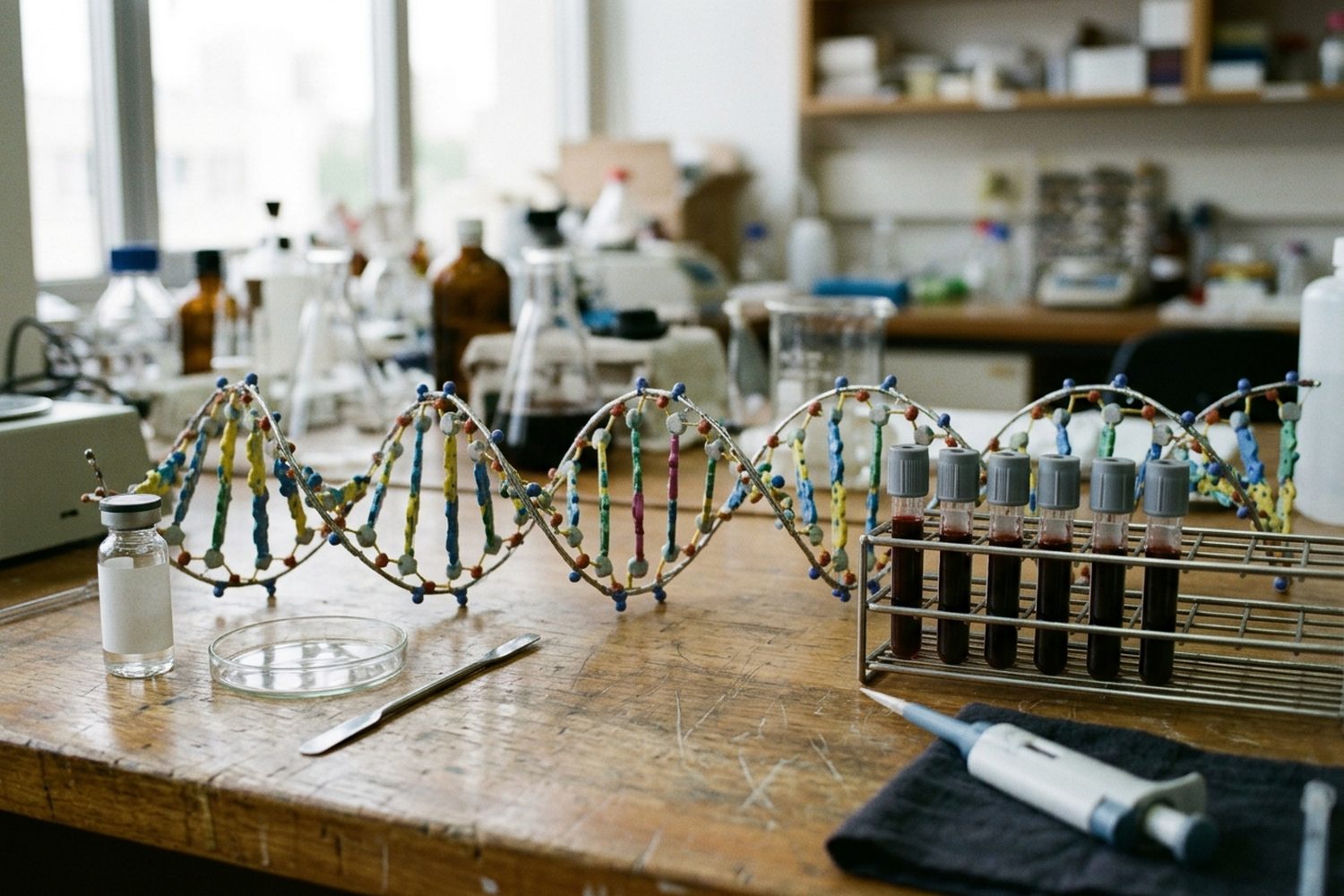
Here is how you build a machine that tells people how old they are. You collect blood from a few hundred people whose ages you already know. You measure a chemical mark at hundreds of thousands of spots on their DNA. Then you ask a computer to find the combination of spots that best guesses the ages you already knew, and you publish the guesses.
That, more or less, is an epigenetic clock. The chemical mark is DNA methylation (other articles on this site handle the chemistry), the spots are called CpG sites, and the guessing is usually done with a statistical method called elastic net regression. UCSF’s summary says the sites in the two original clocks, Horvath and Hannum, “were selected using elastic net regression aimed at producing the most accurate estimate of chronological age.” The Hannum clock was built from the whole blood of 482 people and uses 71 CpG sites. The Horvath clock uses 353, and according to CD Genomics it guesses chronological age across many tissue types with a mean absolute error of about 3.6 years.
Why train a clock to guess something you already know
A sensible person hears this and objects. The number the clock was trained to predict is printed on your driver’s license. If the clock were perfect, it would tell you your birthday, which you presumably knew. Building a very expensive instrument to reproduce a fact available on any government ID (and on most birthday cakes) seems dumb.
The objection is correct. A perfect first-generation clock would be useless. The clock is worth something only to the extent that it misses, and misses in a patterned way. To make up a case: if it says 52 for someone who is 47, the hope is that the extra five years say something about that person’s body rather than something about the lab. So a first-generation clock is faithful to chronological age, mostly, and the interesting stuff lives in its little lapses of fidelity.
This is a strange way to build a measuring instrument. Normally you build a thermometer to measure temperature, and its errors are errors. Here the errors are the product, and the training procedure spends all its effort trying to eliminate the product. It just can’t quite manage it.
Think of the guy at the state fair who guesses your age for a stuffed animal. If he were perfect, nobody would learn anything except that he is good at his job. But if he reliably guesses high for people who have had a rough decade, his mistakes become sort of interesting. The clock is that guy, working from hundreds of clues instead of your hairline. We only care when he’s wrong.
How elastic net picks a few hundred sites out of hundreds of thousands
The mechanical problem is that you have far more variables than people. CD Genomics describes first-generation clocks screening for the CpG loci with the strongest linear relationship to age “from among hundreds of thousands of loci.” Hannum had 482 people. If you hand an ordinary regression hundreds of thousands of inputs and a few hundred answers, it will fit the training data perfectly, by memorizing it, and then be useless on anyone new.
Penalized regression fixes this by charging the model for every weight it uses. Elastic net blends two kinds of charge: one that pushes weak weights all the way to zero, and one that shrinks weights and lets groups of correlated sites share the credit. The model keeps a site only if that site earns more in accuracy than it costs in penalty. Almost everything gets a weight of zero. (This is also roughly how I write these articles, except the regression is more disciplined about what it cuts.) A paper on feature selection notes that the most common approach runs elastic net on all measured CpG sites “without first identifying specific features or CpGs of interest.”
So the 353 sites in the Horvath clock are the 353 places on the genome that matter for aging. Actually, no. They are the set that, given that training data and that penalty, did the cheapest job of guessing age. The regression has no opinion about biology (it is very sure about arithmetic). Swap in a different sample, and I assume some sites drop out and their correlated neighbors step in to do the same job.
Picture the lab meeting. “Okay, it zeroed out basically the whole genome and kept these. Does anyone know what they do?” “Not really. But the error is 3.6 years.” That is a perfectly reasonable exchange, in some sense, because the method never promised an explanation. It promised a fit.
The number of sites is not sacred either. The same feature-selection study reports that its most predictive clock used only 35 CpG sites and reached an R² of 0.87, and that a clock built from just the five sites that showed up most often across its clocks reached 0.83. A skin clock called MitraSolo is built on single CpG sites, while a sibling called MitraCluster uses CpG regions. Hundreds of sites, dozens, a handful. They all tell time.
How the second and third generations changed the target
Once you notice that the errors are the product, the obvious move is to stop training on chronological age and train on the thing you actually wanted. That is what the later generations did. CD Genomics says second-generation clocks like PhenoAge and GrimAge changed the training objective “from predicting chronological age to predicting clinical phenotypes, incidence of disease, and all-cause mortality associated with aging.” The machinery stayed about the same. The answer key changed.
The third generation changed the answer key again. The Scientist describes DunedinPACE as trained on differences in multi-organ system deterioration between individuals of the same age. The Moffitt and Caspi lab, which built it, says the “third generation” label exists because earlier clocks were not derived from longitudinal data on physiological decline in same-age people. Its output is a rate of aging rather than an age, and the lab describes it as the clock most responsive to interventions across studies.
Look, “generation” here sounds like it means better chips, the way phones get generations. It mostly means a different target variable. First generation: guess the birthday. Second: guess the health outcomes and the death. Third: guess how fast someone is declining compared with people born the same year. Each generation is a more direct admission that the birthday was never the point. (Individual clocks get their own articles here, so I will leave them there.)
What the clocks end up measuring along the way
Because the regression keeps whatever predicts, it can keep things nobody meant to measure. A preprint called GIA mapped the CpG sites from 13 published clocks to places where methylation is known to be regulated by inherited genetic variants in blood. Clock sites were enriched for those, 62.7% versus 39.6% for comparable unused sites on the same array, an odds ratio of 2.57.
One reading is that clocks are partly measuring the genes you were born with, which would be an odd ingredient in a gauge of how you have aged since. The other reading is that genetically regulated sites are simply steadier signals, and a penalized regression hunting for reliable predictors would naturally favor steady ones. Those lead to different conclusions about what a clock reading means. The preprint’s numbers do not choose between them.
Other passengers show up too. Research on people living with HIV finds first-generation clocks put them roughly 5 to 7 years older than HIV-negative peers, while noting that this may be confounded by changes in immune cell composition. The Scientist reports that a blood-trained clock applied to saliva without correction can produce substantial errors. Elysium Health (which sells its own test) says technical replicates of the Horvath, Hannum and PhenoAge clocks produced deviations of three to nine years. A study of 18 clocks on the TranslAGE platform found that clocks which were technically robust often proved biologically unreliable across samples taken hours apart.
And there is no shared ruler. The Scientist says the field has not achieved reference standards, so “it is not possible to send a sample to different validated labs and obtain the same biological age readout.” A 2026 systematic review concluded clocks should be treated as exploratory or adjunctive biomarkers, not validated surrogate endpoints. The AMA Journal of Ethics went further and called “biological age” a fiction. I feel like the builders would take that less hard than it sounds, since they started with a number they already knew.
The clock was built to be right about your age. The useful part is where it’s wrong.
Sources
- Choosing Epigenetic Clock Models: Horvath, Hannum, PhenoAge, GrimAge and Beyond - CD Genomics
- Epigenetic Clock | UCSF SMN
- Epigenetic Clocks Power Biological Age Data, But Why Do Results Differ Across Tests? | The Scientist
- Novel feature selection methods for construction of accurate epigenetic clocks
- Elysium Health Launches At-Home Test to Measure Rate of Aging, Biological Age
- The Science Behind Index | Elysium Health
- Epigenetic age predictors for non-invasive assessment of human skin
- Four Aspects to Interpret Epigenetic Clock Results - CD Genomics
- Epigenetic clocks and accelerated biological aging in people living with HIV: Emerging mechanisms and clinical implications
- DunedinPACE | Moffitt & Caspi: Genes, Environment, Health, Behavior
- Biological versus Technical Reliability of Epigenetic Clocks and Implications for Disease Prognosis and Intervention Response
- Concordance between changes in epigenetic clocks and changes in clinical outcomes in geroscience intervention trials: A systematic review
- [2609.17801v1] GIA: Germline-Informed Aging with AlphaGenome Finds Genetically Regulated CpGs
- What Are the Most Ethically Salient Implications of Epigenetic Age Testing? – Dec 2025 | Journal of Ethics | American Medical Association
Bio Clock Test explains published research. It is not medical advice and it does not diagnose anything. We never recommend a test, a supplement or a treatment. Talk to a clinician about your health.