DNA Methylation: The Chemical Tags Clocks Read
The letters of your genome stay put, while the chemical hats on them become a number printed to one decimal place.
Your DNA has small things stuck to it, and an industry now reads them to tell you how old you are. The stuck-on things are methyl groups, and the process is DNA methylation, which Wikipedia describes as “a biological process by which methyl groups are added to the DNA molecule, which can change the activity of a DNA segment without changing the sequence.” The letters stay the same. Some of them just wear hats.
The hats go in particular places. In mammals, methylation is found almost exclusively at CpG dinucleotides (a C followed by a G along the strand), with the cytosines on both strands usually methylated. Which sites wear hats differs between young people and old people, and that difference is the raw material of every epigenetic clock: first-generation clocks such as the Horvath clock were trained, as The Scientist puts it, “by comparing DNA methylation signatures of young and old individuals to predict chronological age.”
What DNA methylation is, in plain chemistry
A cell attaches a small chemical tag, a methyl group, to one of the letters of its DNA. The tagged stretch can then act differently, while the spelling never changes. As of 2016, two bases were known to take natural, enzymatic methylation: adenine and cytosine. The clocks live on the cytosine side, at those CpG sites.
This is a little weird, if you think about it. Your genome is the most famous unchangeable document you own, and the part the biological-age business wants to read is the annotation in the margins. (Like buying a used textbook for the highlighting.)
How one tag becomes an age, one reasonable step at a time
Here is a progression I made up, to show how you get from a hat to a number. It is invented, though you will see it does not stay invented for long.
Step one: look at a single CpG site in a single cell. It is tagged or it isn’t. That is a fact about one molecule and nothing else, and that’s fine.
Step two: look at that site across all the cells in a tube of blood and report the share that are tagged. Still reasonable. A blood sample is a crowd, and crowds have averages.
Step three: notice that at some sites, the share tends to differ between old donors and young donors. Also reasonable. Lots of things differ between old and young people (knees, ringtones, opinions about fonts, etc.), and some of those differences turn out to be useful.
Step four: measure hundreds of thousands of sites at once, because the equipment lets you. Step five: hand all of it to a machine-learning algorithm and ask which weighted combination best predicts the donor’s age. Step six: print the answer in an app, to one decimal place. (The decimal place is doing a lot of work.)
Step seven, to push it until it breaks: skip the blood. Put a piece of tape on someone’s face, peel it off, and read their age from whatever comes off with it. That would be the absurd endpoint, I suppose.
It is not hypothetical. A study of epigenetic age predictors for human skin reports that “Skin biological age can be measured from a person’s face using non-invasive tape-stripping and DNA methylation clocks.” Steps one through six are also just how the field works; clocks do use machine learning on genome-wide methylation data.
Said as plainly as possible, the method is: count hats at a lot of spots, multiply each count by a weight, add it all up, and call the total an age. The official name for this is an epigenetic clock.
The arrays that read 450,000 sites at once
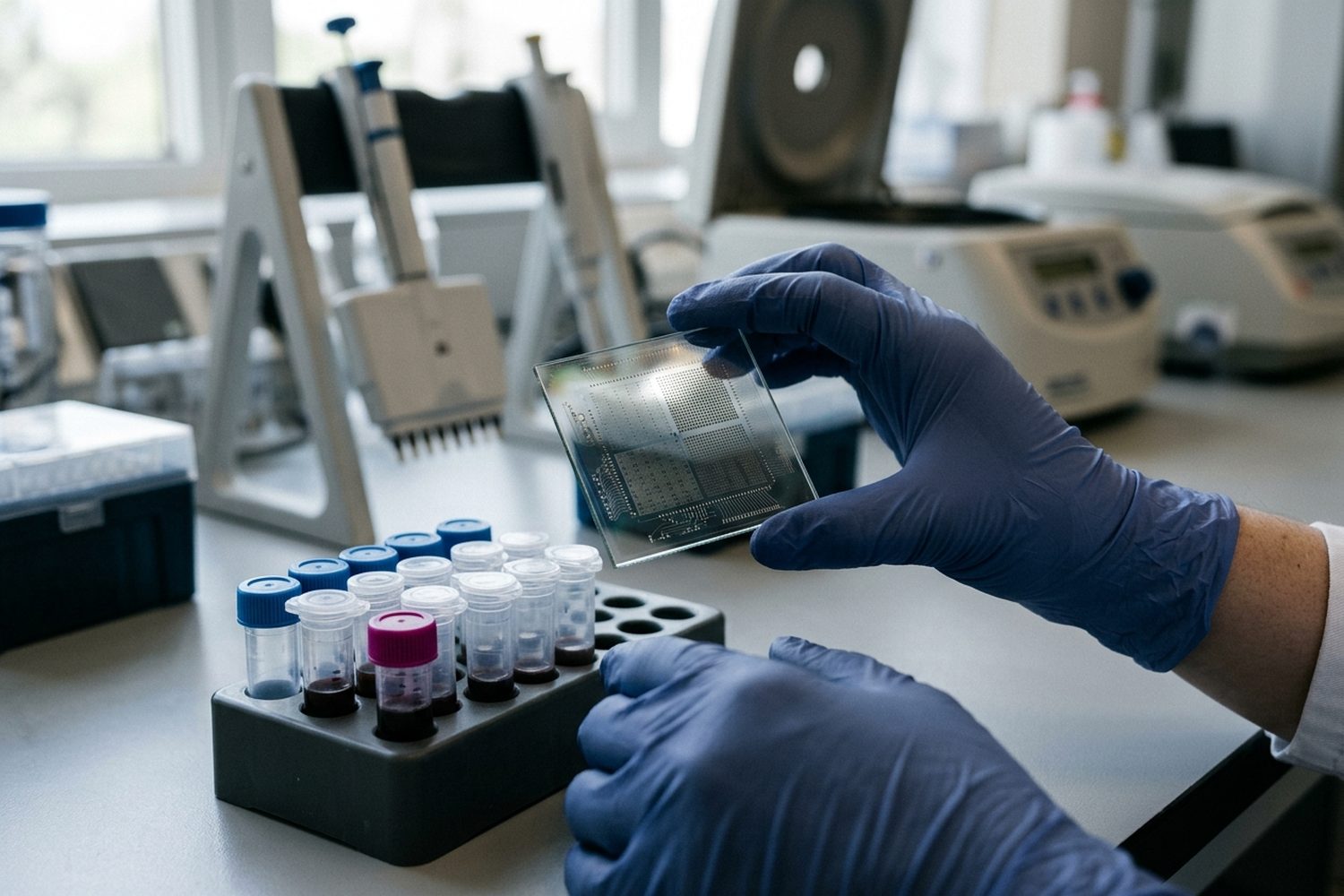
The equipment in step four is usually a methylation array, a chip that reports methylation levels at a fixed menu of CpG sites. The Hannum clock, published in 2013, came from whole-blood methylation profiling of 482 people, at more than 450,000 CpG markers. Another study, working from roughly 470,000 CpGs in whole blood, built clocks that predict age with R² scores above 0.73.
The chips have names like printer cartridges. DunedinPACE can be computed from Illumina 450k, EPIC1 or EPIC2 array data, and a study of childhood lead exposure read ten different clocks off Infinium MethylationEPIC BeadChips. (I explain things for a living and still had to read “BeadChip” three times.)
Arrays are not the only reader. A forensic study tried Oxford Nanopore’s PromethION 2 sequencer on samples under 100 ng of DNA, and found that at low read depth, sites came back with values of exactly zero or exactly one. This makes sense. If you only see one copy, it has a hat or it doesn’t, and you are back at step one.
A separate coverage-aware evaluation of Nanopore methylation callers found that at single-read coverage, estimates were “unstable and strongly method-dependent” across all four callers it tested. Somewhere a technician says, “Hey, this one’s a one,” and somewhere downstream a model treats that as a site that is 100 percent tagged across a whole crowd of cells. (The forensic team did find that a simple linear correction significantly improved accuracy, which is a nice result and also an admission.)
How methylation changes with age, and what is not settled
The sources here establish two things. Methylation patterns shift with age enough to predict age. And the relationship is not constant: researchers behind an algorithm called iTARGET describe “Epigenetic Correlation Drift,” the way the link between methylation and age changes across life stages. Their answer is to sort profiles into age groups first and then fit a separate model for each group.
Which particular sites gain or lose hats, why, and whether those changes cause aging or merely accompany it: the facts gathered for this article do not settle that. I will not pretend they do.
There is also the crowd problem. Blood is a mix of cell types, and different cell types carry different hat patterns, so a shift in the mix can look like a shift in age. First-generation clocks put people living with HIV at roughly 5 to 7 years biologically older than HIV-negative people of the same age, though that gap may be confounded by HIV-related changes in immune cell composition. Is that aging, or a different crowd? It is not settled.
Saliva has the same problem in a bigger way: a clock trained on blood, applied to saliva without correction, can produce substantial errors, because the cell types in saliva carry fundamentally different methylation signatures.
The builders know all this. DunedinPACE, per its paper in eLife, was trained on a methylation dataset “restricted to exclude probes with low test-retest reliability.” That is, they cut the sites that told one story the first time and a different story when asked again the next week. Many people run their social lives on the same policy.
Why everyone keeps adding sites and decimal places
Each party here is behaving sensibly. A lab whose chip returns 450,000 numbers per run would be strange to use only twelve of them. A company cannot hand a customer 450,000 numbers, because the customer asked how old they are, and the honest answer to that question is a single figure. And the customer wants a single figure because a single figure is what the question was.
The researchers have been reasonably upbeat. Podolskiy and Gladyshev, in a review submitted on 14 November 2018, wrote that methylation clocks “provide unmatched accuracy in assessing the biological age of both humans and animal models of aging.” The same review dealt with bounds on clocks’ out-of-sample performance, which is the part where you admit a model has limits.
On the other hand, a 2025 meta-analysis of 24 studies covering 28,325 participants found that raw methylation age, unadjusted for chronological age, showed no association with frailty. I guess that is what you would expect from a number trained mainly to reproduce your birthday. Anyway, the other articles on this site cover what the clocks predict; this one is about the hats.
The letters, again, still haven’t changed. The hats now come off on a strip of tape and go home with a decimal point.
Your sequence, the part you were born with and will die with, has become the boring part.
Sources
- Epigenetic Clocks Power Biological Age Data, But Why Do Results Differ Across Tests? | The Scientist
- Epigenetic age predictors for non-invasive assessment of human skin
- Epigenetic Clock | UCSF SMN
- Prenatal and childhood lead exposure is prospectively associated with biological markers of aging in adolescence
- [2501.02401v1] iTARGET: Interpretable Tailored Age Regression for Grouped Epigenetic Traits
- [1811.06018v1] DNA methylation markers to assess biological age
- Biological age measured by DNA methylation clocks and frailty: a systematic review and meta-analysis
- DNA methylation-based forensic framework for age prediction and body fluid identification using nanopore sequencing
- Novel feature selection methods for construction of accurate epigenetic clocks
- DunedinPACE | Moffitt & Caspi: Genes, Environment, Health, Behavior
- DNA methylation - Wikipedia
- Coverage-aware evaluation of Oxford nanopore methylation callers using whole-genome data
- Epigenetic clocks and accelerated biological aging in people living with HIV: Emerging mechanisms and clinical implications
- DunedinPACE, a DNA methylation biomarker of the pace of aging | eLife
- Genome-wide methylation profiles reveal quantitative views of human aging rates
Bio Clock Test explains published research. It is not medical advice and it does not diagnose anything. We never recommend a test, a supplement or a treatment. Talk to a clinician about your health.