Proteomic Clocks and Organ Ages
Researchers trained a blood protein model to guess an age they already had, and the useful part is where it gets it wrong.
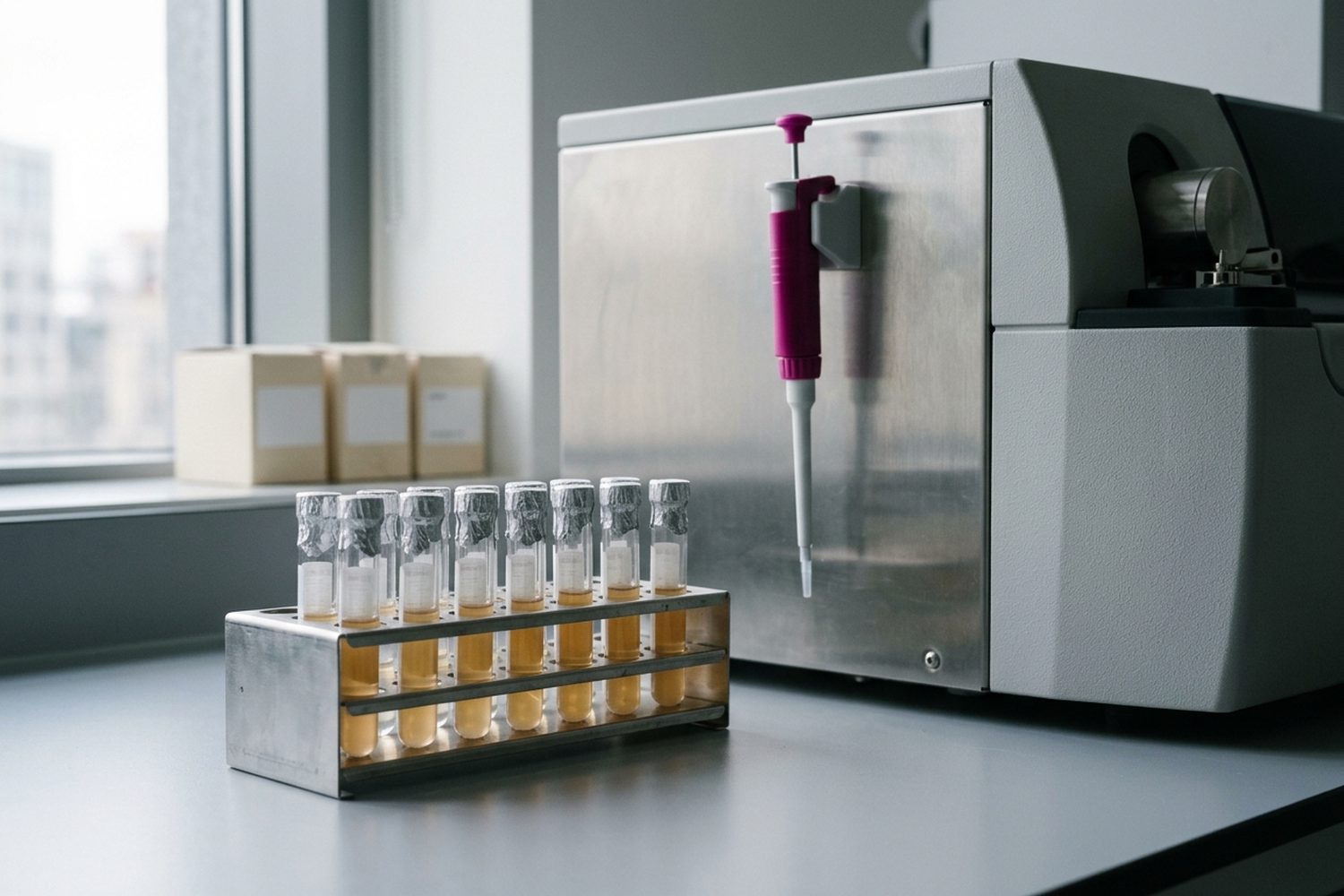
Someone measured 2,923 proteins in the blood of 53,021 people, in something called the UK Biobank Pharma Proteomics Project, and then built a model to guess how old each of those people was. The researchers already knew how old each of those people was. (It was in the spreadsheet, next to their participant IDs or whatever.) This is not a mistake. It is basically the entire method, and it works.
A proteomic aging clock is a statistical model that reads the levels of many proteins in a blood plasma sample and turns them into one number shaped like an age. The useful part is the gap between that number and your actual age. A positive gap is read as faster aging, and in the big biobank studies that gap tracks death and disease better than some older measures. The fair description of the field is early: the best studies are large and replicate across countries, but the clocks run on different machines, in different populations, with different math. The newest offshoot, organ-specific ages, is mostly a promising idea that occasionally has a price attached.
What a proteomic aging clock reads from your blood
DNA methylation clocks, which the rest of this site covers at length, read chemical tags on DNA. Those tags are a bit like the settings on a machine. Proteins are closer to the output: the stuff cells actually make and ship. A review titled “Proteomic ageing clocks: methods, mechanisms and the muscle connection” says the clocks “are predominantly built from blood plasma, capturing inflammatory, metabolic, and extracellular proteins including secreted signaling factors.”
Plasma is used because plasma is what you can get. Biopsying 53,021 livers is not on the table. (The volunteers, reasonably, would have had opinions.) So the clocks read whatever happens to be floating in the blood, including proteins made in particular organs that leaked out or were sent out. The same review notes that muscle clocks rely on “organ-enriched circulating proteins rather than biopsy-derived data.” I am fond of “organ-enriched circulating proteins.” These are proteins that have left home, are out circulating, and still carry traces of where they spent the night.
Why the first thing the clock predicts is your birthday
Here is the problem every clock builder faces. You have a giant table: tens of thousands of people down the side, thousands of proteins across the top. To train a model you need a target column, the thing it learns to predict. The column you actually want, “how worn out is this body,” does not exist. Nobody has a ruler for that. What does exist, for every participant, filled in correctly, is chronological age.
I imagine the meeting goes something like this (I made it up): “We have 2,923 proteins and fifty-three thousand people, what do we train on?” “Age. It’s the only column nobody left blank.”
Let the record therefore reflect that the principal output of the instrument is an estimate of a quantity supplied to the instrument as an input, and that the instrument’s accuracy is assessed by the fidelity with which it returns that input to its owners. The study published under PubMed ID 39117878 trained on 45,441 UK Biobank participants, settled on 204 proteins, and reported a Pearson correlation of 0.94 with chronological age. It held up elsewhere: 0.92 in a Chinese biobank cohort of 3,977 people and 0.94 in a Finnish cohort of 1,990. That is good. The protein signature of getting older is not a quirk of British blood.
But a perfect age predictor would be worthless. If the model hit your birthday every time, it would tell you nothing beyond your birthday. All the value lives in the misses. So the incentive is strange: you want a model very good at guessing age, but not too good, and the residual is the product.
Consider a made-up startup that estimates age by counting candles on birthday cakes in your phone’s photo roll. Its correlation with chronological age would be close to 1. It would beat every protein clock ever published. Its “candle age acceleration” would mostly measure whether your friends ran out of candles at 40 and switched to the number-shaped kind, and people with that acceleration would be flagged as aging slowly. It would raise money on the correlation alone. Then it would launch organ ages, with the heart read off whichever candle sits nearest the frosting rose.
Who pays for the gap, and what it buys
The next link in the chain. Matching birthdays proves the method; showing that the gap predicts something bad is what gets attention, and renewals. The PAC paper reports that its clock “showed stronger age-adjusted associations with all-cause mortality and 18 incident diseases than PhenoAge, BioAge, or leukocyte telomere length.” The 39117878 study tied proteomic aging to telomere length, to a frailty index, and to reaction time, which covers the biological, physical and cognitive bases in one go.
The proteins doing the work look like aging biology, which is reassuring. In PAC they were enriched in immunoinflammatory responses, cellular senescence, extracellular matrix remodeling and vascular biology. In the other clock they were involved in hormone regulation and reproduction, neuronal structure and function, and development and differentiation. The funders on the 39117878 paper include the Wellcome Trust, the British Heart Foundation (both listed with the same grant number, CH/1996001/9454, for reasons the facts don’t explain), and NIH grant P30 DK043351. A heart charity is going to want disease prediction. (Few charities exist to confirm birthdays.) It’s fine. That is what the gap is for.
Now a puzzle. PAC’s correlation with chronological age was 0.77 (Spearman), noticeably below the 0.94 elsewhere. One reading: PAC gave up some birthday accuracy and got more biology in return, since the misses are where mortality lives. The other reading: these are different models, different correlation measures and different choices, and the two numbers were never built to be lined up side by side. Both fit what has been published.
How a blood test becomes a liver age
The chain keeps going. If one clock is good, a clock per organ sounds better. The recipe is basically to take proteins enriched in a given organ and build a clock from just those. The study “Multimodal clocks of human aging” built a “three-tiered aging framework comprising the CC-clock, MM-clock, and organ-associated aging clocks,” and argued that plasma protein clocks “serve as efficient proxies for systemic physiological capacity.” (What exactly CC and MM stand for is not in the facts I have.) It also flagged age-dependent buildup of coagulation factors as a driver of multi-organ senescence and inflammation, which is a causal claim, and causal claims in this field are the expensive kind.
Note what “organ age” means here. It is not a scan of the organ. It is proteins from that organ, observed after they have traveled to the arm, run through a model whose training target was mostly your birthday. Meanwhile, on the consumer side, TruDiagnostic’s TruAge says it covers “organ-specific aging for 11 body systems including brain, heart, and liver,” across 64 biomarkers; how those organ numbers are built is not something the facts here settle, and another article on this site covers that product.
How reliable the proteomic aging clock is right now
The big biobank numbers are strong. The smaller studies show how fragile the setup can be. A Moscow study enrolled 350 adults aged 19.8 to 99.1, measured plasma by mass spectrometry, and got a mean absolute error of 11.83 years from an 8-protein model. The state-fair guy who guesses your age for a dollar looks at your face and probably does better, lol. The authors also found that age and sex distributions “differed strongly across 27 MS batches,” which they called “a major confound.” Put plainly, the machine runs may have known who was old before the proteins did.
The review “Proteomic aging clocks in epidemiological studies” says the clocks “vary widely in their assay platforms, study populations, and modeling strategies,” which may limit generalizability. It also lists three possible jobs: discovery biomarkers, predictive biomarkers and response biomarkers. That last one, a number that moves when an intervention works, is the one everybody wants, and it is the one nobody has shown yet. An older paper, on the other hand, argued that methylation clocks have “unmatched accuracy” against other omics. That contest is not settled either.
You and I both know which figure ends up on the slide. Anyway, the proteins in your blood know how old you are. That part is done.
Sources
- Proteomic ageing clocks: methods, mechanisms and the muscle connection
- Proteomic aging clock (PAC) predicts age-related outcomes in middle-aged and older adults
- Proteomic aging clock predicts mortality and risk of common age-related diseases in diverse populations
- Age-Associated Plasma Protein Signatures and Proteomic Age Estimation by Data-Independent Acquisition Mass Spectrometry in a Russian Cross-Sectional Cohort
- TruDiagnostic™ Biological Age Test
- Multimodal clocks of human aging
- Proteomic aging clocks in epidemiological studies: advances, applications and prospects
- [1811.06018v1] DNA methylation markers to assess biological age
- Proteomic aging clock (PAC) predicts age-related outcomes in middle-aged and older adults
Bio Clock Test explains published research. It is not medical advice and it does not diagnose anything. We never recommend a test, a supplement or a treatment. Talk to a clinician about your health.